How to Practice 6/8 & Compound Meters
A compound meter is any time signature whose beat divides naturally into three — 6/8, 9/8, and 12/8 are the common ones. Instead of counting a steady "1, 2, 3, 4," you feel a rolling, lilting pulse where every main beat carries three little notes inside it: "1-2-3, 1-2-3." Think of a fast waltz, a jig, "We Are the Champions," or the swaying feel of many blues and doo-wop ballads.
The single most common mistake is counting 6/8 as six even beats. It usually isn't. This guide shows you how compound meters really work, how to count them out loud, and how to set up a metronome that groups the beat visually so your eyes and ears agree — which is exactly where the app's beat captions and downbeat marker come in.
Simple vs. Compound: The One Idea That Unlocks 6/8
Every time signature answers two questions: how many and what kind. In compound meters, the honest answer is a little sneaky.
- Simple meter (2/4, 3/4, 4/4): each beat splits into two. You count the beat and the "and" — "1-and-2-and."
- Compound meter (6/8, 9/8, 12/8): each beat splits into three. You count "1-2-3" or "1-la-li" inside every pulse.
Written vs. felt, at a glance:
- 6/8 — six eighths written; felt as 2 dotted-quarter beats grouped (1 2 3)(4 5 6).
- 9/8 — nine eighths written; felt as 3 dotted-quarter beats grouped (1 2 3)(4 5 6)(7 8 9).
- 12/8 — twelve eighths written; felt as 4 dotted-quarter beats grouped (1 2 3)(4 5 6)(7 8 9)(10 11 12).
How to Count 6/8, 9/8 & 12/8 Out Loud
Counting out loud is the fastest way to internalize the grouping. Pick a system and stay consistent:
- Straight numbers: "1 2 3 4 5 6" — say the big beats (1 and 4) louder.
- Beat-plus-subdivision: "1 la li 2 la li" — this keeps the big-beat number ("1", "2") on the downbeats and names the inner notes "la li." Many teachers prefer it because your count already tells you how many main beats there are.
- "1 e & a" per cell: borrowed from sixteenth-note counting, useful when you subdivide even finer.
The trap with all of these is the repeat: "1 2 3 1 2 3" looks identical for each group, so it's easy to lose your place. That's the problem the metronome solves for you.
Set Up the Metronome to Group the Beat for You
A plain click just goes tick tick tick — it never tells you where a group starts. On metronomeonline.app you can make the beat show you the grouping in two complementary ways: the compound subdivision remap and beat captions with a downbeat marker.
1. Let the app remap subdivisions to the compound pulse
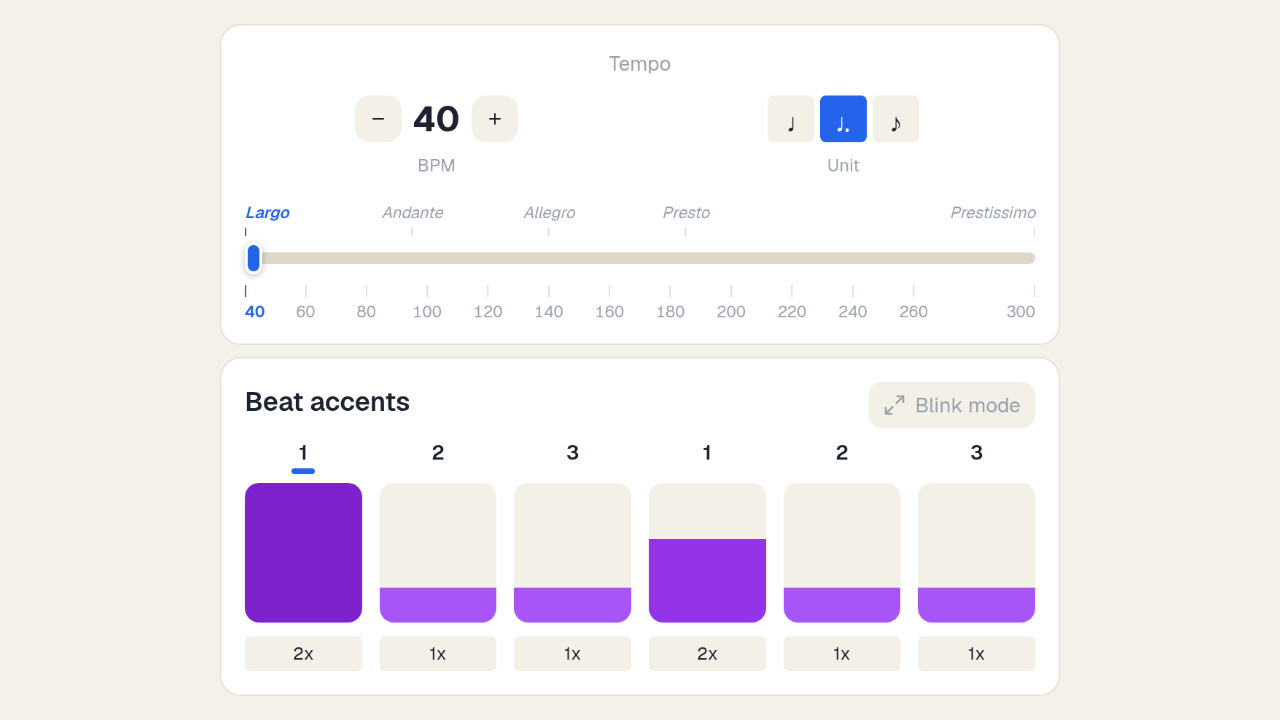
When you put the metronome in a compound feel (a dotted-quarter pulse), the subdivision control stops thinking in twos and starts thinking in threes. Concretely:
- pressing 2× plays 3 clicks per big beat, and
- pressing 4× plays 6 clicks per big beat.
2. Caption the grouping "1 2 3 1 2 3" — and mark the downbeat
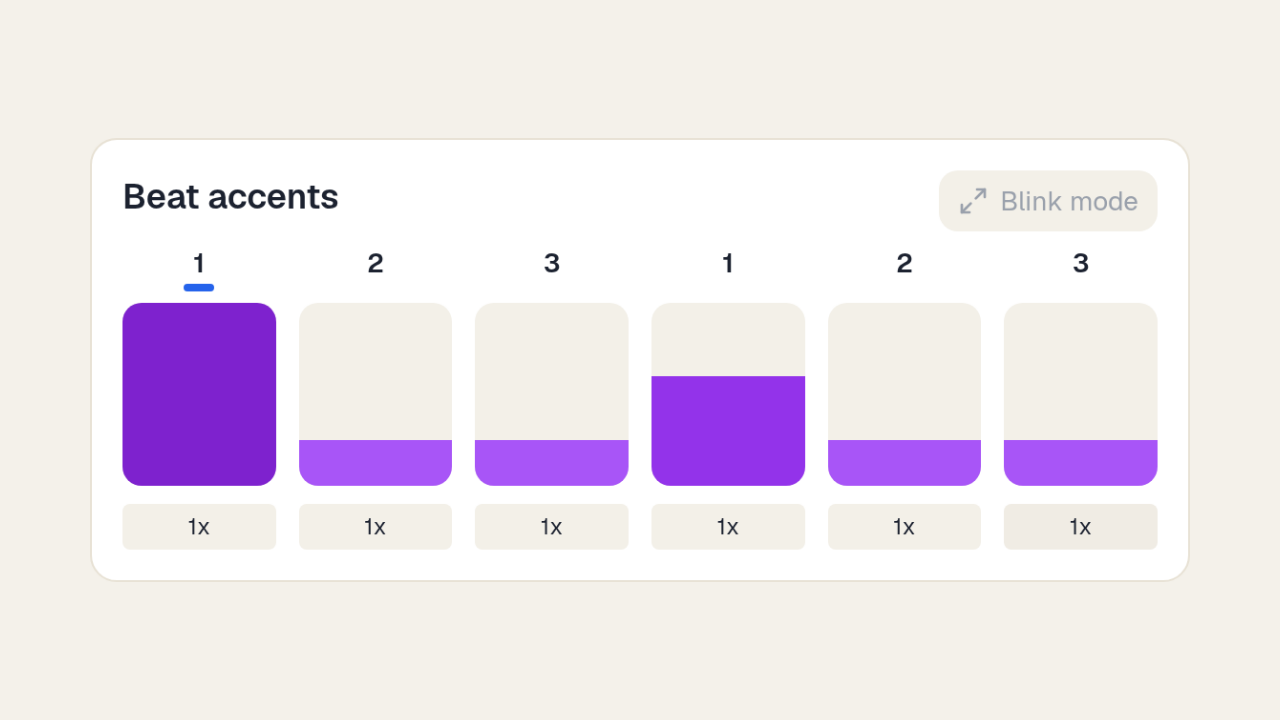
Here is the feature that makes compound meters click. Click any beat to rename it, typing your own short label. Caption your bar of 6/8 as:
``
1 2 3 1 2 3
``
Now the metronome literally spells out the grouping as it plays. And because "1 2 3" repeats, the app puts a downbeat marker under the first beat — a small indicator that disambiguates the two identical-looking groups so you always know which "1" is the true top of the bar. Your eyes confirm what your ears are counting.
A few honest limits worth knowing:
- Captions are short — 4 characters per beat. Plenty for "1", "la", "& a", "TAKA", but not a full word.
- They reset when you change the time signature. Switch from 6/8 to 4/4 and your labels clear, so re-caption after a meter change.
- They persist through saved presets, not the URL. Save a preset to keep your 6/8 caption layout; sharing a link won't carry the labels (it carries tempo and meter, not per-beat captions).
Vocalization Systems: Say It the Way That Sticks
Captioning the beat pairs perfectly with saying the beat. Different traditions vocalize the same grouping differently — use whichever locks the feel in for you:
- Numbers: "1 2 3 1 2 3" — clearest for reading and teaching.
- "1 e & a" per cell: when you subdivide a beat into a grid, you can caption each cell of a beat as "1", "e", "&", "a" (using the beats-as-grid approach — treat inner cells as their own beats to label them individually).
- Konnakol (South Indian solkattu): the syllables "ta ka di mi" for four, "ta ki ta" for three — a rigorous, ancient system for speaking rhythm. Caption a triple grouping "TA", "KI", "TA".
- Multilingual counting: count in your first language. The point is a syllable per pulse that you can say fast and evenly, not the specific words.
Practice loud rooms with Blink mode
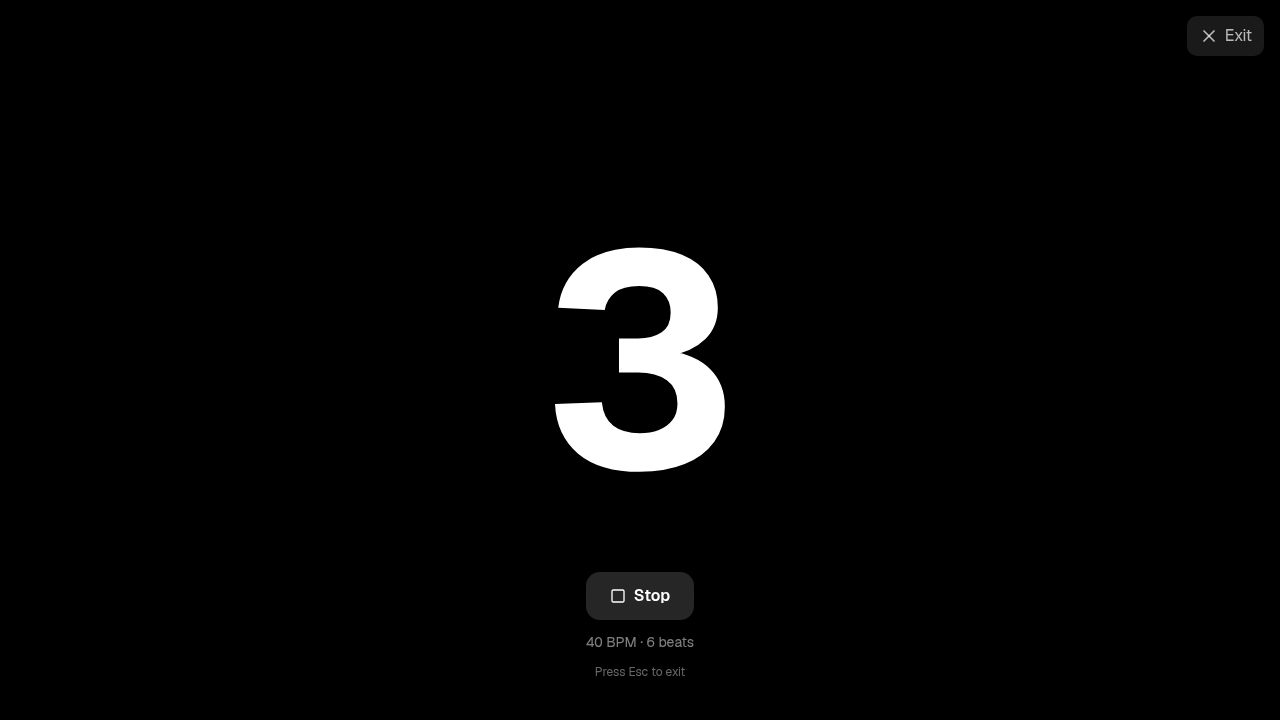
Rehearsing with a drummer or in a noisy room where you can't hear the click? Blink mode turns the whole screen into a silent visual metronome — and it shows your caption full-screen on each beat. So you can read "1 2 3 1 2 3" flashing large across the screen and keep the compound grouping even when the click is buried under the band.
A 10-Minute 6/8 Practice Routine
1. Set the pulse slow. Two big beats, dotted-quarter feel, around 50–60 BPM per big beat. Count "1 2 3 4 5 6" out loud, accenting 1 and 4. 2. Add the inner three. Turn on the compound subdivision (2× → three clicks per beat). Feel every eighth without losing the two-beat pulse. 3. Caption the bar. Rename the beats "1 2 3 1 2 3" and watch the downbeat marker. Say the numbers with the labels. 4. Drop to two. Silence the inner subdivision and feel just the two dotted-quarter pulses — the click on 1 and 4 only. This is the real 6/8 feel. 5. Switch feels. Toggle between counting all six and feeling just two, without stopping. That flexibility is what playing compound meters musically actually requires.
Want to build custom rhythms inside the beat — like a gallop — instead of even subdivisions? See our companion post on practicing gallop rhythms. To go deeper on how beats split in general, read what subdivision means in music or open the metronome with subdivisions. And if reading the beat helps more than hearing it, the visual metronome foregrounds Blink mode and captions. Curious how meters are built and notated? See the time signatures guide.
Conclusion
Compound meters feel hard only until you stop counting them as flat rows of eighths and start feeling the big beats with three inside each. Count it out loud, let the metronome remap subdivisions into the triplet pulse, caption the grouping "1 2 3 1 2 3," and lean on the downbeat marker so you never lose the top of the bar. Do that for ten minutes a day and 6/8 stops being a puzzle and becomes a groove.
FAQ
Q: How do you count 6/8 time? A: At most tempos, count 6/8 as two main beats, each split into three eighth notes: "1 2 3 4 5 6," with the accents on 1 and 4. This gives you two dotted-quarter pulses — the natural lilting feel of 6/8. Only at very slow tempos do you count all six eighths as deliberate, even beats.
Q: Is 6/8 the same as 3/4? A: No. Both bars contain six eighth notes, but the grouping is different. 3/4 is a simple meter felt as three beats of two ("1-and 2-and 3-and"), while 6/8 is a compound meter felt as two beats of three ("1 2 3, 4 5 6"). The notes are the same length; the emphasis and the pulse are not — 3/4 accents in threes, 6/8 in twos.
Q: What is a compound meter? A: A compound meter is a time signature whose main beat divides naturally into three equal parts rather than two. 6/8, 9/8, and 12/8 are the common compound meters. Their pulse is the dotted-quarter note (which equals three eighths), giving the characteristic rolling, triplet feel.
Q: How many beats are in 6/8? A: It depends on how you feel it. There are six eighth notes written in the bar, but at typical tempos 6/8 is felt as two main beats — two dotted-quarter pulses — each containing three of those eighths. So "six" is the note count, while "two" is the felt beat count.
Q: What is the dotted-quarter feel? A: The dotted-quarter feel is the compound pulse. A dotted quarter note equals three eighth notes, so each main beat in 6/8, 9/8, or 12/8 is one dotted quarter that rolls across three inner notes. Feeling the dotted-quarter pulse — rather than six or nine even eighths — is what makes compound meters groove.